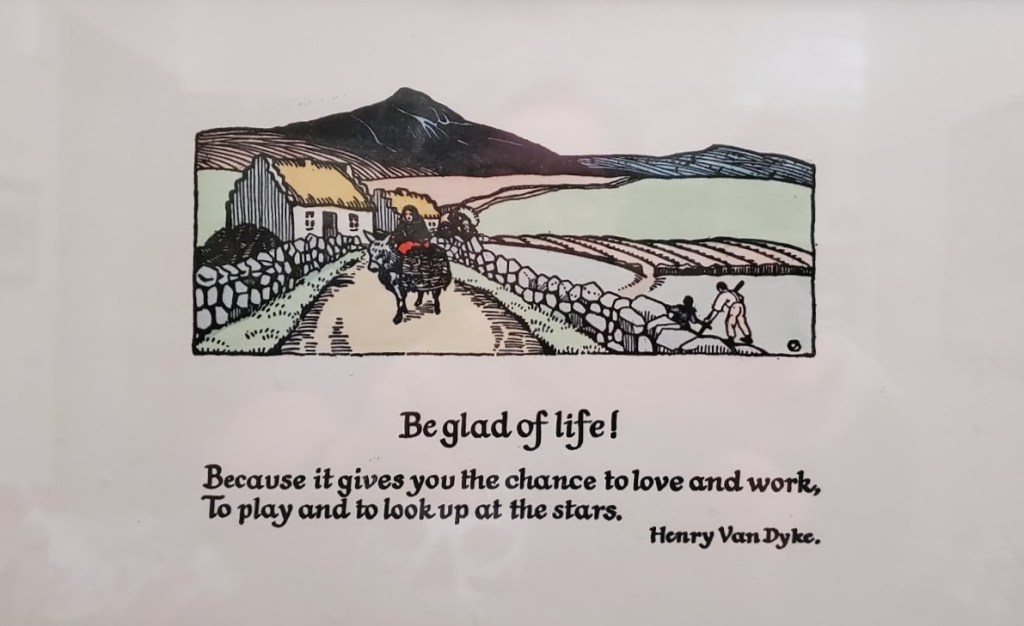
Whew! That last post felt like a slog. It’s not that philosophical thoughts are, in my view, a waste of time… but, real life goes on, and if the thoughts don’t result in a greater sense of equanimity, what’s the point?
So, I want to lighten up, bring all that research and rumination about Stoicism down to a practical level, focusing on the parts of it that keep me balanced emotionally.
One night a few weeks ago, I went to bed musing about why I’m spending so much time learning and thinking about Stoicism. I don’t usually scroll on my phone after going to bed, but that night I did, only to land on an article called Why I Am Not a Stoic by Mariana Alessandri, a philosophy professor. (Kind of spooky how my phone seems to know what I’m thinking.) Although she previously considered herself to be an existentialist, every year she encouraged her students to live like a Stoic for one week and report how it went. Her students found it a useful exercise. At one point, Alessandri attempted to adopt Stoicism as her philosophy, then gave it up and returned to existentialism. Here’s her reasoning:
“My final break with the practice of Stoicism came in 2020 while learning more about the bestselling author and stoic Ryan Holiday. He writes eloquently about Admiral James Stockdale, a POW in the Vietnam War for almost eight years. Stockdale used Stoic practices to not “break” under torture, thanks to having read Epictetus three years prior to his capture… The fact that Holiday regards Stockdale as a modern-day exemplar of Stoicism finally pushed me over the edge. It convinced me that Stoicism is an amazing tool and a near-perfect philosophy … for prison.”
My friend Ilse Rasmussen was born in Germany in 1930 and lived there until the mid 1950’s, throughout and after the Nazi regime. She emailed the morning after receiving the fledgling Stoic post:
Wow, Susan, that was a LOT of work. How interesting. As an Ex-Stoic, I will tell you that Stoicism is not a life sentence. Time and place play a role. During the war years, it was only normal to be stoic as we understood that we had absolutely no control of our lives, never knowing when the next bomb would fall. And when you live on a continent where 55 million of your fellow human beings are killed, death is no longer scary.
I understand how lower-case stoicism can be absolutely necessary in extreme situations like Ilse’s and Admiral Stockdale’s. Stockdale, having read Epictetus before being imprisoned, purposely practiced upper-case Stoicism. For both Ilse and the admiral, so much was beyond their control that the only power they had was to get through it the best they could.
So, why would I adopt Stoic practices when I’m not in prison or living in Nazi Germany? Until now, I have never felt the need to align myself with any specific philosophy of life. The teachings of Jesus are very much still with me from years of church and Sunday school. They still resonate and are in harmony with Stoicism, as well as with Unitarian Universalism, the faith I now embrace. I have never been without a moral compass — that is not the issue. My problem is that occasionally, though I appear to others to be competent and effective, I lapse into inner free-floating angst. I’d prefer not to do that anymore.
Richard and I recently watched the 2015 movie Bridge of Spies, in which a lawyer (Tom Hanks) has the unenviable job of defending a Russian spy (Mark Rylance). The spy character is hated equally by the Americans and the Russians, who suspect he might have revealed secrets, but as he faces the challenges of his trial and hostage negotiations, he remains impassive. Each time it looks like he is out of options, the Tom Hanks character asks him, “Aren’t you worried?” And every time, the spy answers, “Would it help?”
Good point. It won’t.
let the rubber hit the road
We are heading back to Phoenix in a few days. The situations that I foresee that could disrupt my equilibrium are these:
- Disquiet about how the election will turn out
- Returning to my volunteer ESL tutoring knowing that I will have too many students and too little time with them
- Committing myself to eating well and keeping up an exercise routine (despite my love of munching at will and the temptation to skip stretching and workouts)
So — three potentially anxiety-provoking situations to use as opportunities to test what I’ve learned, and to find out whether thinking like a Stoic helps.
The election
We’ve contributed what we can to support candidates up and down the ballot, and I’ve participated in GOTV (get out the vote) efforts. At this point, how the election turns out is not under my control. So should I worry? “Would it help?” No.

The Stoic practice that can be useful here is the view from above. Zooming out to consider all the political pendulum swings that have occurred over time, then zooming out further and further to put this election, as crucial as it is, into a larger perspective.
By the time we survey all the universe from a vantage point in the stars, something significant has happened. Perspective has been gained. Our own life—with all of its pressing worries and wonderings, distracting loves and longings, compelling dreams and ambitions—has been relocated to its proper place in the grander context. aesop.com
Another way to think about it: I need to save the energy I would use up being anxious before the election in order to have the energy and “courage to change the things I can” after the election — however it turns out.
Volunteer teaching
Last year was my first try at teaching ESL (English as a Second Language) rather than helping 4th-5th graders with math. Math was easy. No lesson prep was necessary. I had been teaching math (and other subjects) for 45 years, and I could “fly by the seat of my pants” and be effective, and the students made progress.
When I took on teaching ESL, I was out of my element. I am an excellent (and loquacious) English speaker myself, but teaching English requires a skill set that I did not have.
Last year, in addition to three 90-minute sessions with kids, I spent 10-12 hours per week watching how-to videos, reading how-to articles, scrambling for materials, making flashcards and photocopies, and trying to plan meaningful lessons for each session. Even when I was not prepping, I was fretting over what to teach and how to teach it. The ESL students were (and will be again) 7th- and 8th-graders, nervous about social acceptance, not wanting to risk making mistakes, and full of rushing hormones. All of this kept them from engaging their minds. They were far more interested in chatting (in Spanish) and making each other laugh than in learning.
I realized about halfway through the school year that I was not enjoying my students. I resented them for thwarting my earnest efforts to help them learn English. This was a new feeling for me, and I was perplexed until I realized that I was so invested in making them learn that I had forgotten to personally connect with them. That has always come naturally, but frantic preparation, having too many kids in my sessions, and frustration with my ineffectiveness had kept me from feeling the affection I normally have for kids. After that insight, I made a point of meeting the students individually or in small groups. Although this shortened the teaching time for each one, the quality of the experience was enhanced for all of us. So I know to start with connection when I meet them next week.
The dichotomy of control is relevant in this situation, too. I cannot control the number of kids there will be who need to learn English, but to save my sanity, I can choose to limit the number in my teaching sessions. This goes against the grain for someone who wants to embrace and help all the English language learners. But smaller groups give the students a more positive learning experience, so my time with them will be more satisfying for me as well. I need to find the courage and humility to not take on more than I can handle — to accept my limitations.
Taking care of my body
I learned years ago that I’m better at maintaining an exercise routine when I know that someone is at the gym waiting for me to show up. So, starting next week, I have set up three 30-minute workouts with a trainer each week, plus two “duet” Pilates sessions with Richard. Good for me, I guess, but what I need in addition to coaches is to remind myself daily that I’m not just a brain, that I live in my body as well. A hard lesson for one who was essentially raised as a Puritan.
I love to eat. It is very rare for me to miss a meal, forget to eat, or refuse a snack. I eat lots of vegetables, which is great, but I also eat lots of everything else — not so great. I currently look and feel as if I am wearing a fully inflated flotation device around my middle. I felt this way during the pandemic when I wrote the post pudge, plants and puzzles. Most of my adult life, especially since having kids, my weight has fluctuated rather wildly. I really enjoy my slimmer times, and I am told that at least theoretically, I’m in control of my intake, but…
I’ve used Weight Watchers several times over the years, and maybe I will again? It feels like putting myself back in harness, but followed correctly, it works for me. Learning to Eat the Stoic Way by Donald J. Robertson gives me some Stoic guidance on diet — why does it always come down to moderation!? — but I know that, just like with exercise, I am more successful when I’m accountable to someone. In this case, it’s an app. Or maybe I’ll find a dietician to get me started? We’ll see.
moving southwARD AND onward

I meant to include a photo of my new piano last time — here it is. I’m enjoying playing it, but only when I take my hearing aids out! It’s in a smallish room, so too much resonance…
Richard told me his favorite part of the last post was the two videos below. They appeared at the bottom, after I described my “new” piano and how a piece I’m working on is challenging because I don’t have huge, Rachmaninoff-sized hands. I repeat them here at his suggestion. After a long, way too serious “essay,” they would have been easy to miss.
Now this kid, for his age, has amazing technique and hand span!
A custom-made inspirational poster

 itsjustapuzzle.com
Hi Susan, I always enjoy reading about your thoughts and your life! Looking forward to seeing you back in Phoenix, Peg
LikeLike