We have moved back to our Flagstaff retreat. Here’s what I hope to do in the next few months:
- Complete a 40-hour online course in TEFL (Teaching English as a Foreign Language), which, in common parlance, is learning to be an ESL teacher. I’ve been volunteering with ESL students at a nearby elementary school in Phoenix. This year I had three native Spanish speakers and one Ukrainian student new to the US. I fumbled through it, maybe making some difference, but feeling inadequate. I don’t enjoy feeling inadequate.
- Play piano and viola for fun
- See a couple of tutoring students on Zoom
- Do jigsaw puzzles
- Eat well
- Take walks with Mac
- Study and read Spanish to review, improve fluency, enlarge vocabulary
- Address sciatica pain by daily stretching and using foam roller to maintain some degree of comfort
- Buy and repot new houseplants. The ones at this house were left by the former owner and miraculously survived for a while, but most died over the winter.
- Plant some flowers in existing outdoor containers
- Go through a dozen banker’s boxes full of photos, family papers, and undoubtedly some surprises. Scan or toss. These boxes have followed me around for too many years.
- Get house maintenance and repair jobs done, some by Richard and/or me, some by hiring others
- Write a few blog posts
Having such a long list of “must-do” items sounds onerous and exhausting.
This morning, I read a NYT “The Morning” email about others’ plans for the summer. They all seem to consist of activities the writers look forward to. I too would like to enjoy what I’m doing. Hmmm… If enjoyment becomes the theme, the list items feel more like “may-dos” and, at my best, I can see them as joyful opportunities. I do not dread doing any one thing on the list. After all, I chose them. It’s the number of items that I listed that feels burdensome.
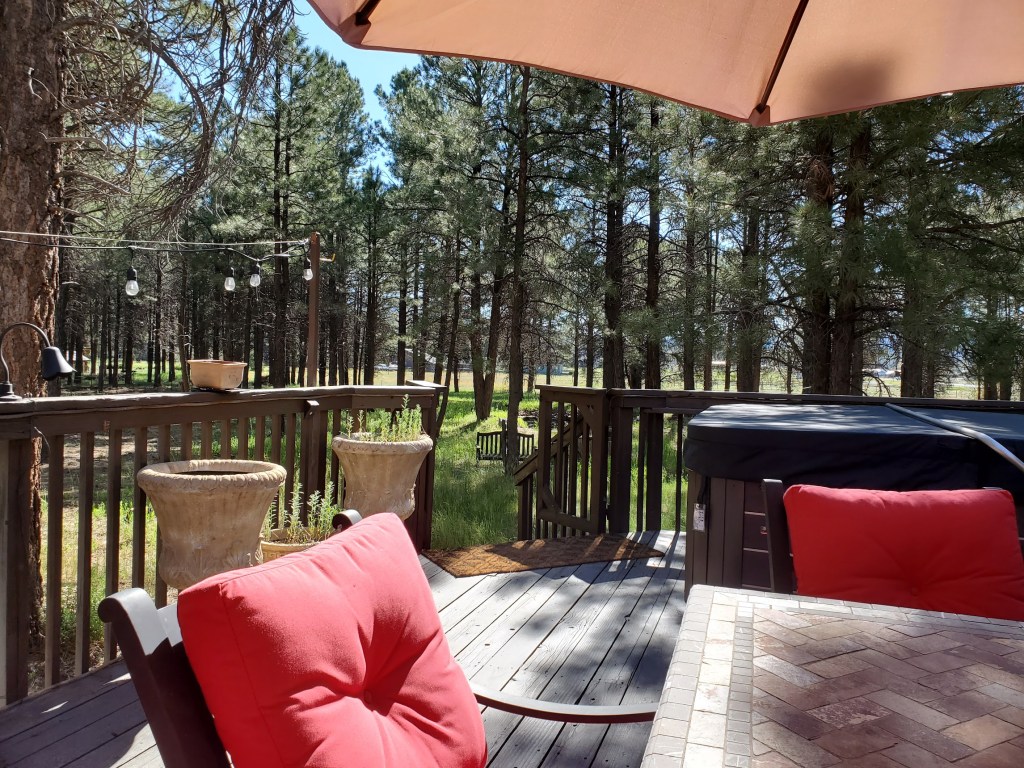
By chance, before reading the NYT piece, I initiated a new outlook this morning by bringing my laptop outside to our deck to write. Instead of sitting at my desk facing a wall, I have a backdrop of green and gentle motion: trees, long grass, sunshine, welcome shade under an umbrella, Mac exploring the territory (hoping for squirrels to chase), quiet traffic on the nearby highway, birds vocalizing, fresh air, and the sweet scent of pines.
Why did I not think to do this last summer? Well, I had my reasons: recovering from a knee replacement two months before moving up here, getting settled, making the house comfortable, and then spending a couple of months in the oven that is Phoenix selling a big house, buying a patio home, and making the move from one to the other.
Although there is still a lot to do at our mountain house, I am physically well for my age — every positive report on my health must be followed by the qualification “for my age” — and the big move in Phoenix is done. As the cobbler suggested in the article above, I would like to enjoy my time. I am adopting that as my theme.
It’s been a week and a half since I wrote what’s above. I can’t say I’m having a good time. I may need to pick a different summer theme. Enjoyment is eluding me. Why?
Challenges to my enjoyment of time
Loneliness
I love being in Flagstaff, but I have no friends here… yet. We live about seven miles out of town. It’s just a 10-minute drive, but practically speaking, we are pretty isolated. Yes, Richard is here, and we are friends as well as spouses. We share thoughts and feelings, and have some interests in common, and enjoy each other’s company, but… I’m used to interacting with a variety of other people, too, and I lose a sense of who I am when those interactions are not available.
In the months before we drove north, anticipating the need to connect to others, I tried enrolling in a fun, non-credit course at the community college here, but the sparse summer offerings were of no interest to me. I searched in vain for gardening classes, partly because I would like to have more knowledge about plants, but I also hoped to make some connections with other learners. Cooking classes seemed like a possibility, too, but I couldn’t find those either.
I have been doing Pilates (at a remedial level) for a year or two, and was finally successful in reserving, two months in advance, one individual and two group sessions a week at an excellent studio. I like going and the other women in the class are welcoming, but they have busy lives and are off to do other errands or activities when class is over. I still hope to get to know at least one or two of them better… we’ll see.
On the bright side, I just found a weekly Sunday morning “Meetup” for coffee and Spanish conversation. I was planning to attend a service or two at the local UU congregation, and may still do that, but this Sunday, I’m going to drop into the Meetup.
Until I find my people here, I am relying on my friends in Phoenix and other places around the country for support and companionship. But I’m not giving up on making connections here. It will likely take some time.
brain chemistry – depression
I have been medically treated for depression for 35 years, half my life. This may be a surprise to those who know me and see me cheerfully interact with others. Being able to do that, however, does not mean that there is not an underlying propensity to despondency. Taking antidepressants has lifted me into sunlight, although there are times when situations trigger my default sense of hopelessness. In general, I function well, or at least appear to.
My earliest memories of childhood involve intense self-consciousness. I often felt out of step with other kids, believing that they had, at some time when I had been absent, learned “the rules” of how to interact and survive socially. I watched them closely and occasionally experimented with “being normal,” but ended up trying too hard, blundering and feeling confused and humiliated. It took me years — until high school — to find small groups of people with whom I could be less guarded and more authentically myself, but outside of those groups, the intense self-consciousness resumed.
My junior year of college, I had my first full-blown episode of depression. I felt exhausted, often sleeping through my morning music theory class, and the professor advised me to see the doctor at the health center on campus. That doctor visit was the strangest one of my life. He told me to take off my shoes and kneel on a chair, facing the back of the chair with my ankles dangling from the front edge of the seat. He then placed electrodes on the soles of my feet and tapped multiple times on each of my Achilles tendons. The resulting reflex reactions were shown visually on a readout, kind of like an EKG. (I wondered whether my not-quite-suppressed giggles at the ridiculousness of the situation would affect the readings. No way to know now.) From that readout, he confidently diagnosed hypothyroidism, and prescribed a thyroid supplement. When I didn’t get better, he increased the dosage until I was taking a crazy amount. After college, I saw another doctor who, when he saw the dosage I was on, told me to stop taking it and come in six weeks to have a blood test. It showed a perfectly normal thyroid level.
The overdose of thyroid caused no permanent problem, though I was able to consume incredible amounts of food and not gain weight… until I stopped taking the supplement. I have tried, without success, Googling the kneeling in a chair exam and told many people, including doctors, about it. I couldn’t find anything through Google, and it seemed as strange to the doctors as it was to me. But I just Googled it again, and happened on this 2007 article that connects Achilles reflex response to hypothyroidism. I also found multiple references to a connection between depression and low thyroid function. So maybe the doctor wasn’t a complete quack. After all, he had the equipment to do the test. Maybe the Achilles tendon response that was recorded also indicated depression. If so, he didn’t know that.
About ten years after college, a therapist I was seeing suggested that I might have clinical depression. Perhaps my constant sobbing was a clue? I was referred to a psychiatrist, who prescribed a now-outdated antidepressant. The depression lifted some, but the side-effects, particularly the cotton mouth, were awful. Since the introduction of newer, better medications, I have been on them continuously. I have friends who eschew (what a quirky word!) medications of any kind. Even the ones that are eschewable. Ha. More power to them, but given the workings of my brain, when it comes to antidepressants, I embrace the slogan of that old DuPont commercial: “Better living through chemistry.”
BRAIN CHEMISTRY – add
As if depression alone were not a major obstacle to cheerfulness, I found out about ten years ago that I also have mild ADD. A psychiatrist who was new to me, as part of her intake procedures, had me fill out a self-rating form. I wasn’t too far into it when I realized it was an ADD screening rating. I had seen many of these in my years of teaching. I was alarmed to see how consistently I chose “often” and “very often” as the answers to multiple choice options. The questions included
- How often do you misplace or have difficulty finding things at home or work?
- How often are you distracted by activity or noise around you?
- How often do you leave your seat in meetings of other situations in which you are expected to remain seated?
Sure enough, my answers indicated ADD. This was a revelation to me. Both Richard and our son Sam have ADD diagnoses, and I took credit for having more executive function than either of them. I am high-functioning for a person with ADD, but the effects of distractibility and lacking control over my focus can make “normal” activities, things I appear to do easily, mentally challenging.
I live in my head, where voices are constantly telling me what to do or chastising me for failing to get busy. Yes, those voices generally keep me on track, but they also preclude living in the present, being aware of my body and the environment, and… enjoyment. I started taking a small dose of Ritalin in the mornings and have been amazed to discover how easy it is to accomplish the things I struggled to do before. It didn’t exactly make me happier, but it brought a clarity that stilled my self-criticism, at least for a while. It makes a better start to the day.
A lifetime of living with depression and struggling to focus, exacerbated by the constant, critical supervision of my tyrannical brain, have given me a habit of mind that medication can’t always overcome, especially when I’m alone too much. Which leads me back to loneliness. I get energy and perspective from being with people. Not in noisy places, not with crowds of people, but with conversation and connection. Writing is also therapeutic. Naming what I’m feeling and considering my situation with objectivity centers me. It works even when I’m only writing to myself, but it works much better when I know that what I’m writing is being read by friends who love me. It’s my side of an authentic conversation. Please know that I am open to hear your side, written or spoken, even if it’s as long as this post is.
focusing on enjoyment
Some of you may remember “Hints from Heloise.” I thought it was long gone, but it seems it’s still being published in the Washington Post. Heloise knows everything: the difference between light and dark brown sugar, how to remove skunk smell from your car, how to turn bread heels into a tasty dessert, and so much more. One article title I chortled at is “Hints from Heloise: Spit cup is a huge turnoff on blind date.”
For now, I must be my own Heloise and come up with a few tips to help me experience a more consistent enjoyment of my time. I’ve already mentioned that I need to make efforts to maintain connections with the many friends I already have, and continue seeking situations where I can find others. I’m out of the heat of Phoenix, and spending time outdoors is almost always an option. Keeping my body moving is enlivening, too, now that I’m more or less rehabbed from last year’s knee surgery. I need to balance the time I spend sitting in front of my computer, doing jigsaw puzzles, and studying Spanish with walks around our property and elsewhere.
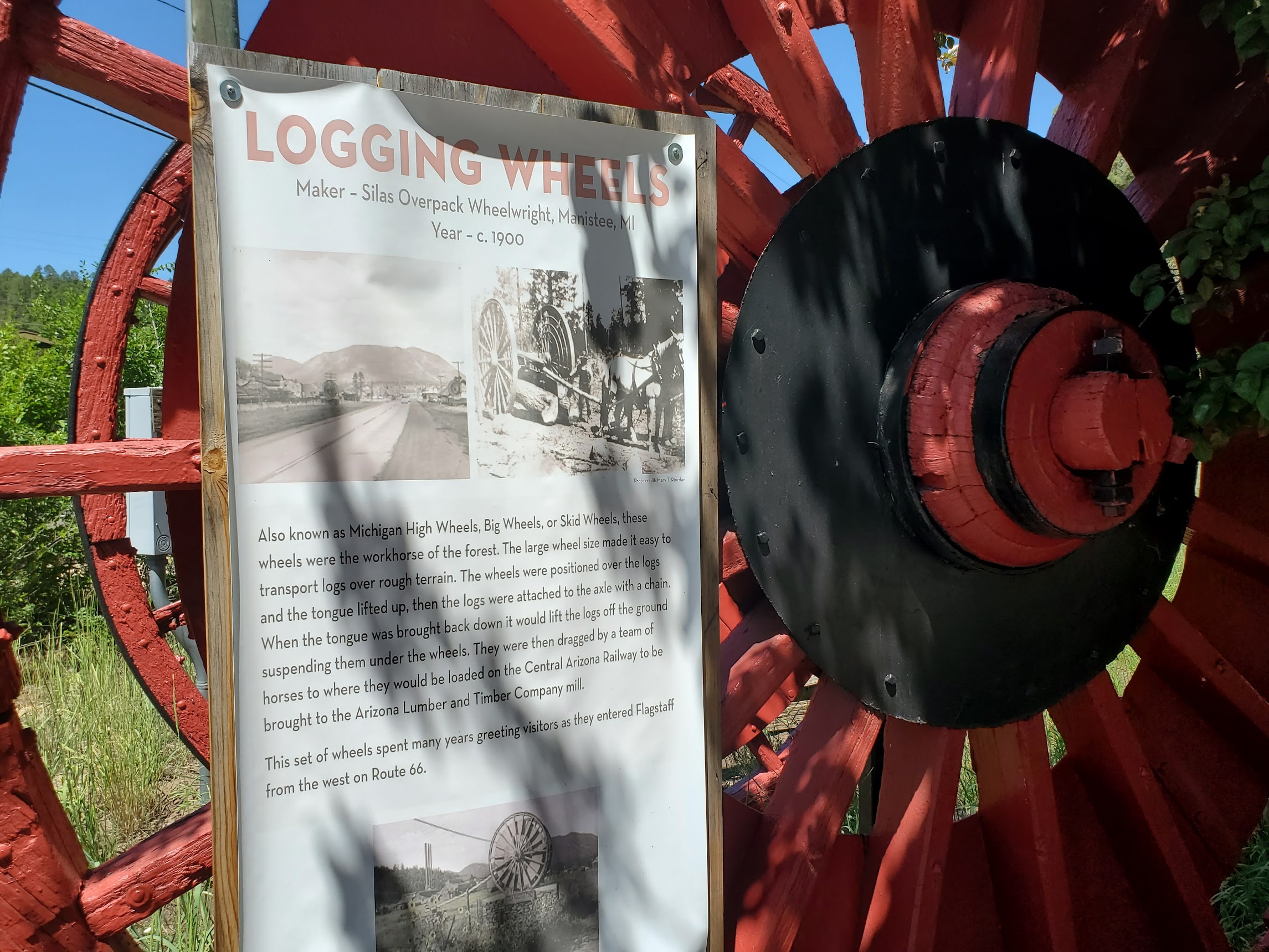
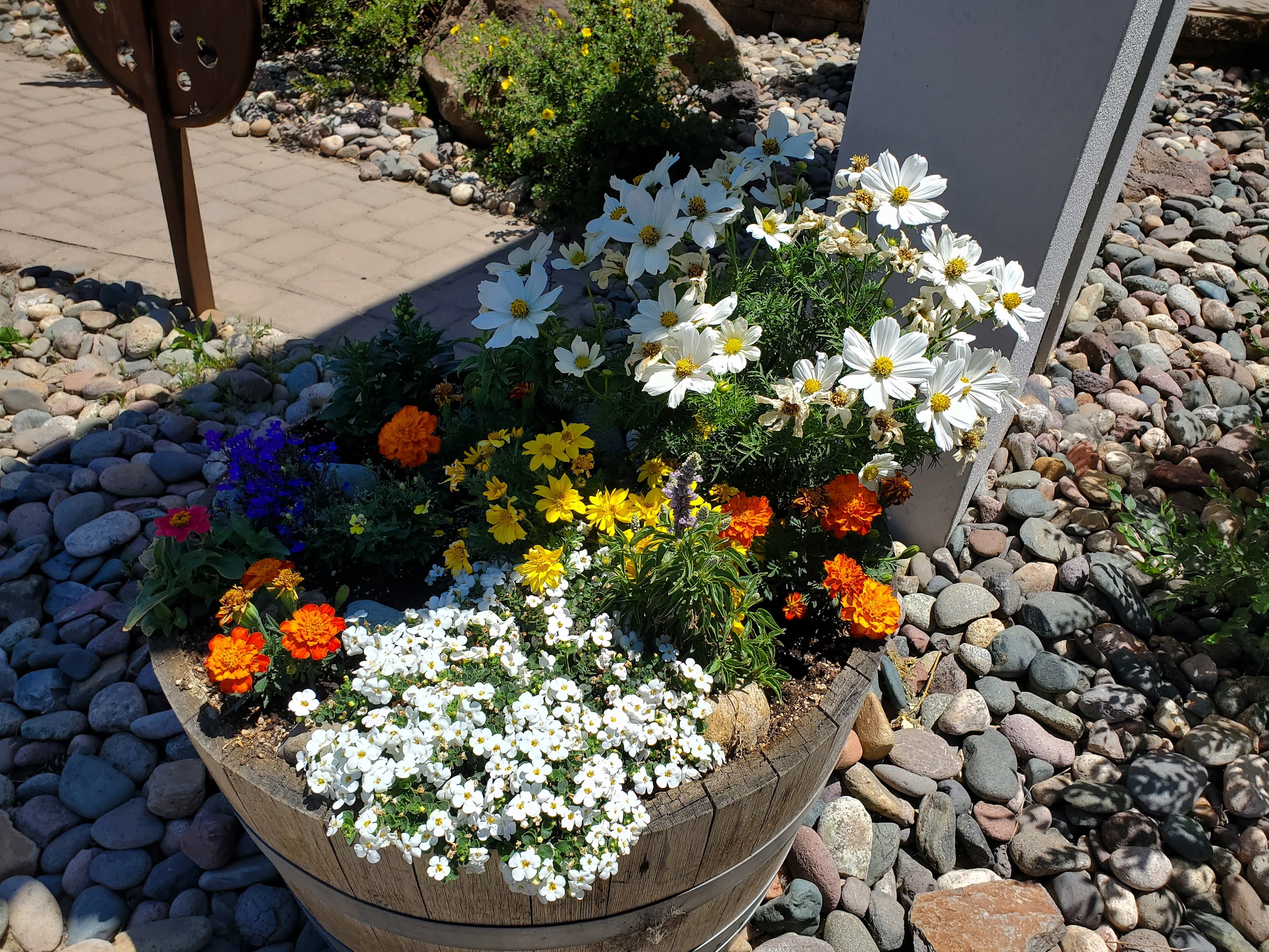
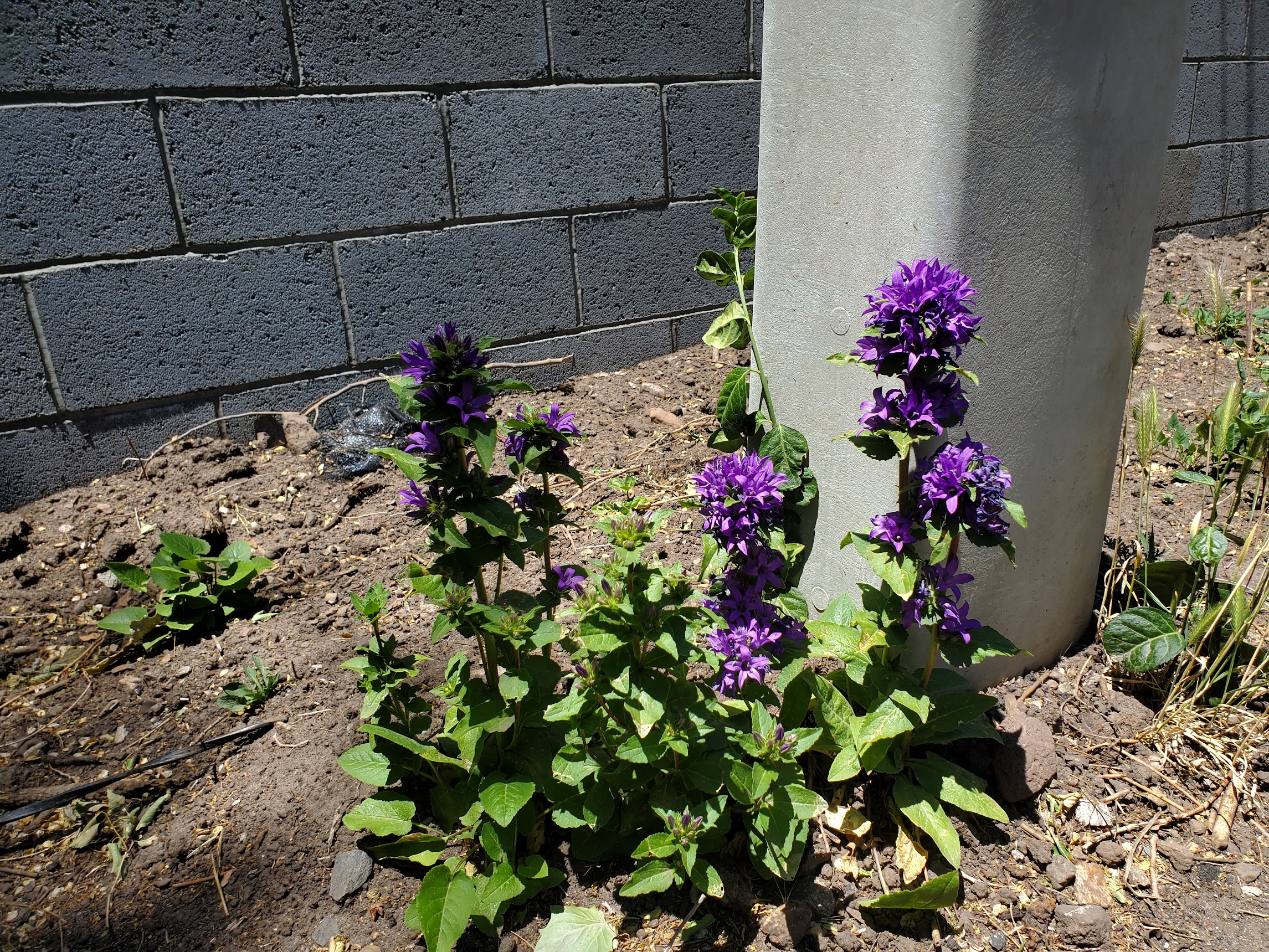
This morning, I drove a few miles down the highway toward Flagstaff, parked a mile or so from a coffee shop I like, walked there, sat down for a while with a glass of iced tea, then walked back to the car and drove home. As we walked, Mac stopped regularly to sniff and raise his leg, and I stopped to take photos. There was so much to sniff, and so much to see. We walked by the Pioneer Museum, which I’ve never visited, and read about logging wheels for the first time. Even the paved walking path had its attractions, flowering native plants — or were they beautiful weeds? What’s the difference? What makes a weed a weed? Must ask Heloise…



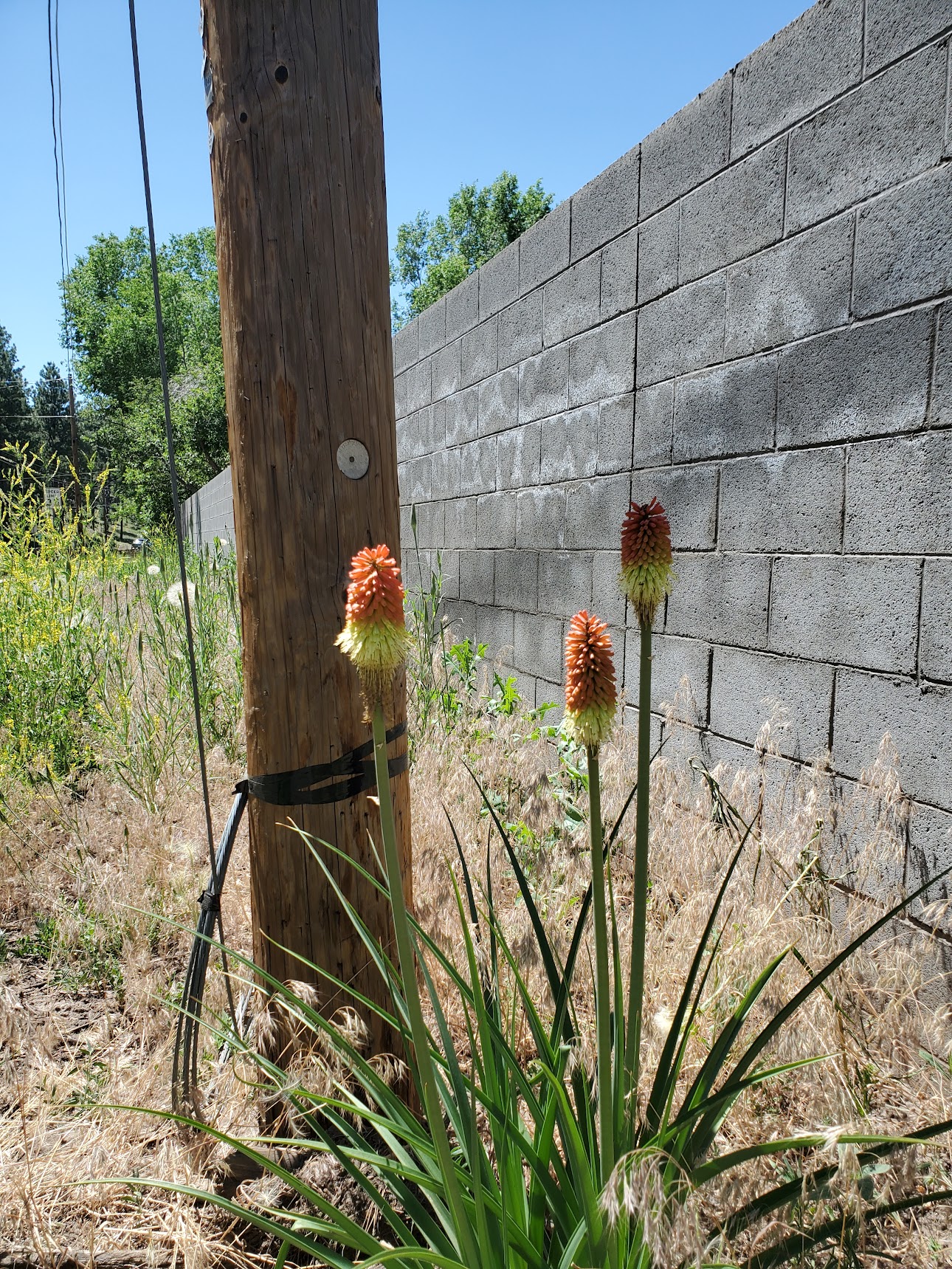
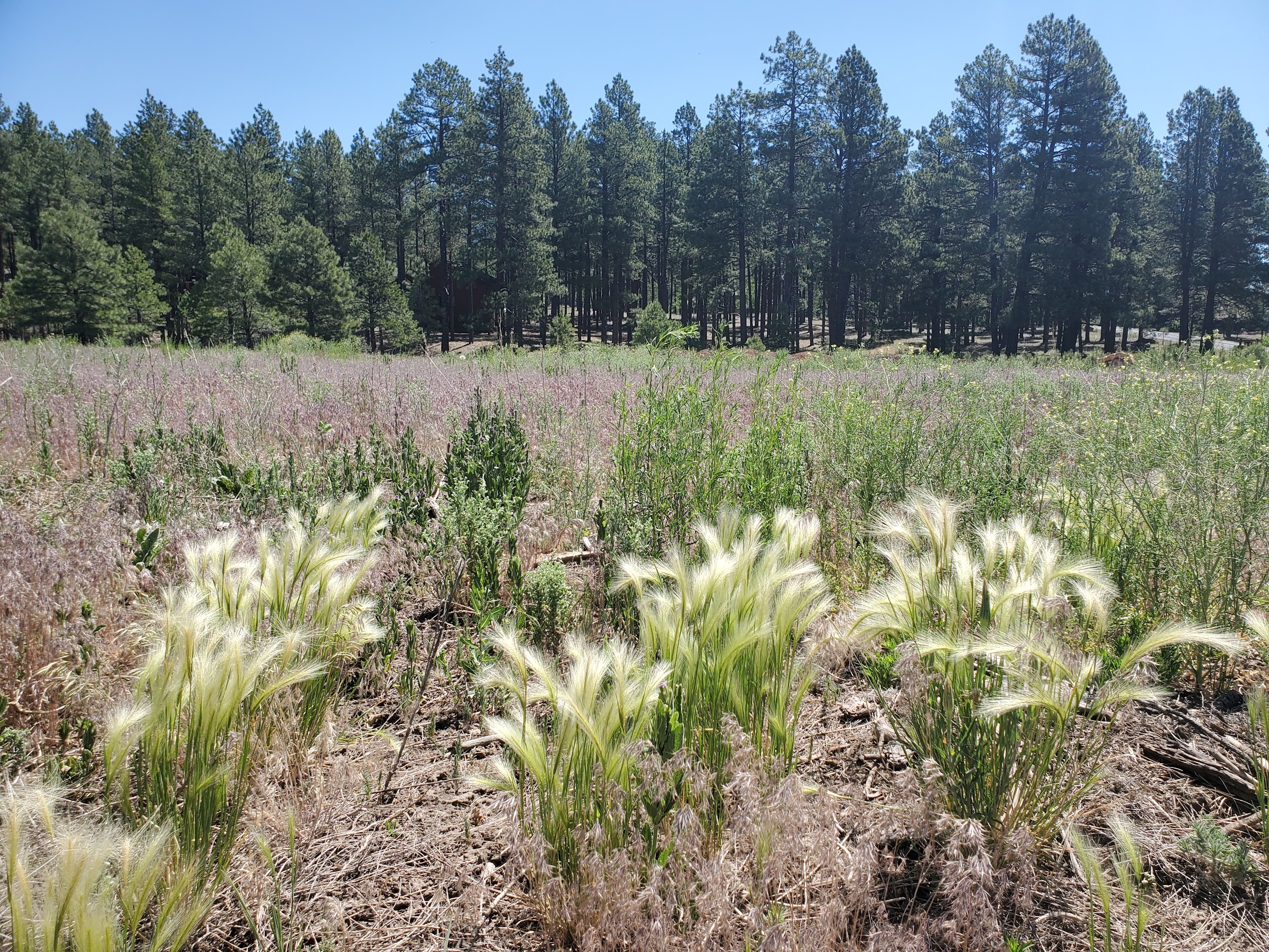
And then there’s Mac…
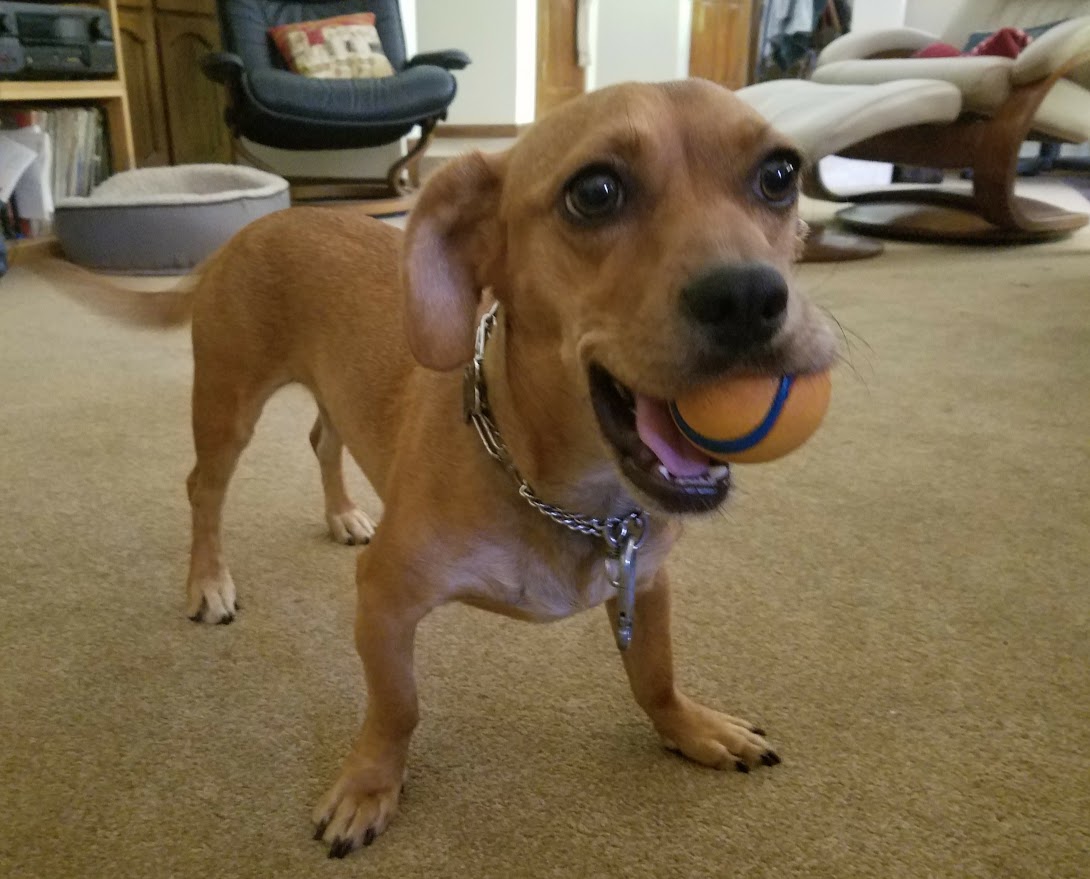
This guy has brought us so much joy. Our daughter Katie found him wandering around a school playground in L.A., fell in love with him, but already had three dogs in a very small house. She convinced us that he was perfect for us, and after a trial weekend to find out whether he could coexist with the three cats we had then, he became ours and we became his. Other than his utter unwillingness to play fetch (he much prefers keep-away), he is delightful. He has an uncannily expressive face and ears, as you can see in this 25-second video.


What else do I enjoy? Everything on that long list I started with. I need to remember that I am among the world’s most fortunate humans, and have so much to be grateful for. Shushing that voice in my head that tells me I’m somehow doing something I shouldn’t be doing, or neglecting to do something I should be doing, is crucial. Oh, yeah, breathing helps, too. And the realization that I don’t have to do everything all at once. I can approach the activities one at a time, step by step, and I have the freedom to rest when I feel like it, too.
So okay. Back to enjoyment as theme. I can do this.
During the pandemic, I joined in a short series of Zoom lessons on how to play Celtic music given by Clíodhna Ní Aodáin, a cellist in Ireland. Although I am still not able to produce the wonderful Celtic string sounds I love to hear (nor can I pronounce the cellist’s name), I admire her musicianship and outreach. A year ago, Clíodhna put out a call for cellists around the world to participate in a project called Cellos for Trees. Here’s the result. I love seeing players of all ages, and this kind of collaboration is inspiring.
And here’s the one puzzle I’ve done in Flagstaff. It was fun — one that requires leaving the edges for last.

I’m done talking now. Thanks for listening.
 itsjustapuzzle.com
Hi Susan,
I recently saw a Arizona PBS program about the Arboretum of Flagstaff. The place looks terrific and I thought you might enjoy a visit, so check it out.
See you soon, Danny
LikeLike
Danny, you are the first to have your reply come through to me! As you know, Camille wrote a bunch and it didn’t reach me. She and I just caught up on Zoom, but it was frustrating for her.
We went to the Arboretum here many years ago, when the kids were in their teens, to attend a raptor display. It was incredible to see owls, hawks, maybe a falcon? up close and watch them fly from tree to tree for food. The barn owl made NO noise in flight. It really made a impression on me. When R had a seminar up here, we got some friends all excited about it only to find out they don’t do it anymore. If you’re interested in the Arboretum, maybe we can go there when you come up in August… Love, S
LikeLike
That would be great…
LikeLike
Susan your thoughts are insightful, diverse, introspective, wide ranging, thoughtful and candid. I sure love the beat of your drummer. I sure miss hanging out with you. Keep the blog coming. Love, Jane
LikeLike
WOW Susan, you dumped alot of stuff in a short space. I have never been tested for any psychological issues but if I were, I’m sure some would jump out. I admire your courage in dealing with these problems. I’m sure you will in time find a group of people for friendship. In the meantime, take care and be gentle with yourself. Bob
LikeLike
Bob, I thought I replied to this yesterday? If you didn’t get it, I want to thank you for your loving words. Since I published that post, things are looking up. I’m hearing from friends in Phoenix (like you!) and making inroads into friendships here… Love, S
LikeLike
I truly enjoy your blogs, Susan, and can frequently relate to so many of your struggles. Fortunately, depression isn’t one I can relate to. I’m glad you have found the help you need through medication. Good for you, for having goals, writing them down, and announcing them to all of your followers 😄 But don’t beat yourself up if you don’t accomplish all of them. I think you should include “me time, to do whatever I want for an hour or more a day” in that list. Even if what you want to do, is accomplish something on that list. Sending love💗.
LikeLike
“Don’t beat yourself up” is something I need to hear regularly, Jenny… As I’ve gotten older, taking breaks for me time have become more of a necessity. I don’t often schedule “time off,” but I feel mentally or physically fatigued more frequently and no longer have what it takes to force myself beyond a certain point. I’ve received so much support after posting this one. I feel comforted and lifted up by my loving friends like you! I’m happy you joined CE just to give us more time to get to know each other. You bring such a thoughtful presence to the team… Love, Susan
LikeLike
Hi Susan! I am not sure if this will work or not but, somehow, I lost your regular e-mail address. My old e-mail still works but my new one is RiaButterfly9@outlook.com RiaButterfly9@outlook.com . I won’t write too much here since not sure if you will get it or not but thank you for the nice note. I would LOVE to have lunch sometime. Next week I am still a little busy due to Brint’s BIG 65 B-day but starting the week of 2/26, I am pretty open. I hope this e-mail works! Ria
LikeLike